
The AI SEO Checklist for UAE Businesses: How to Get Recommended by ChatGPT, Gemini and Perplexity
Try this. Open ChatGPT and ask it to recommend a business like yours in Dubai. Then ask Gemini and Perplexity the same thing.
Did your business come up? For most of the companies I speak to, the answer is no. A competitor did, and that competitor gets the call.
That’s what AI search looks like now. Your buyers ask a question and get a shortlist of three or four names. There’s no page two to scroll to. If you’re not on the list, you don’t exist for that question.
This AI SEO checklist covers the 14 things that decide whether you make that list. Plenty of it is good old SEO. Some of it is new, and a few parts are specific to doing business in the UAE. Work through it in order, tick off what you’ve already done, and put your energy into the gaps.
Why this matters more in the UAE
UAE businesses and consumers have taken to AI tools faster than most markets. Your buyers are already using them to shortlist suppliers, compare prices and check reputations before they ever fill in a form.
AI search also works differently from a normal Google search, in three ways that matter:
- You’re either on the shortlist or you’re not. An AI answer names a handful of businesses. Ranking eighth doesn’t help when only three get mentioned.
- It checks your story. Before an AI recommends you, it compares your website with your directory listings, reviews, news mentions and social profiles. If they don’t match, it hesitates.
- People ask longer questions. Instead of typing “SEO Dubai”, they ask something like “Which SEO agency in Dubai works with B2B tech companies and shows its pricing?”
The upside is that it’s still early here. Most of your competitors haven’t touched any of this.
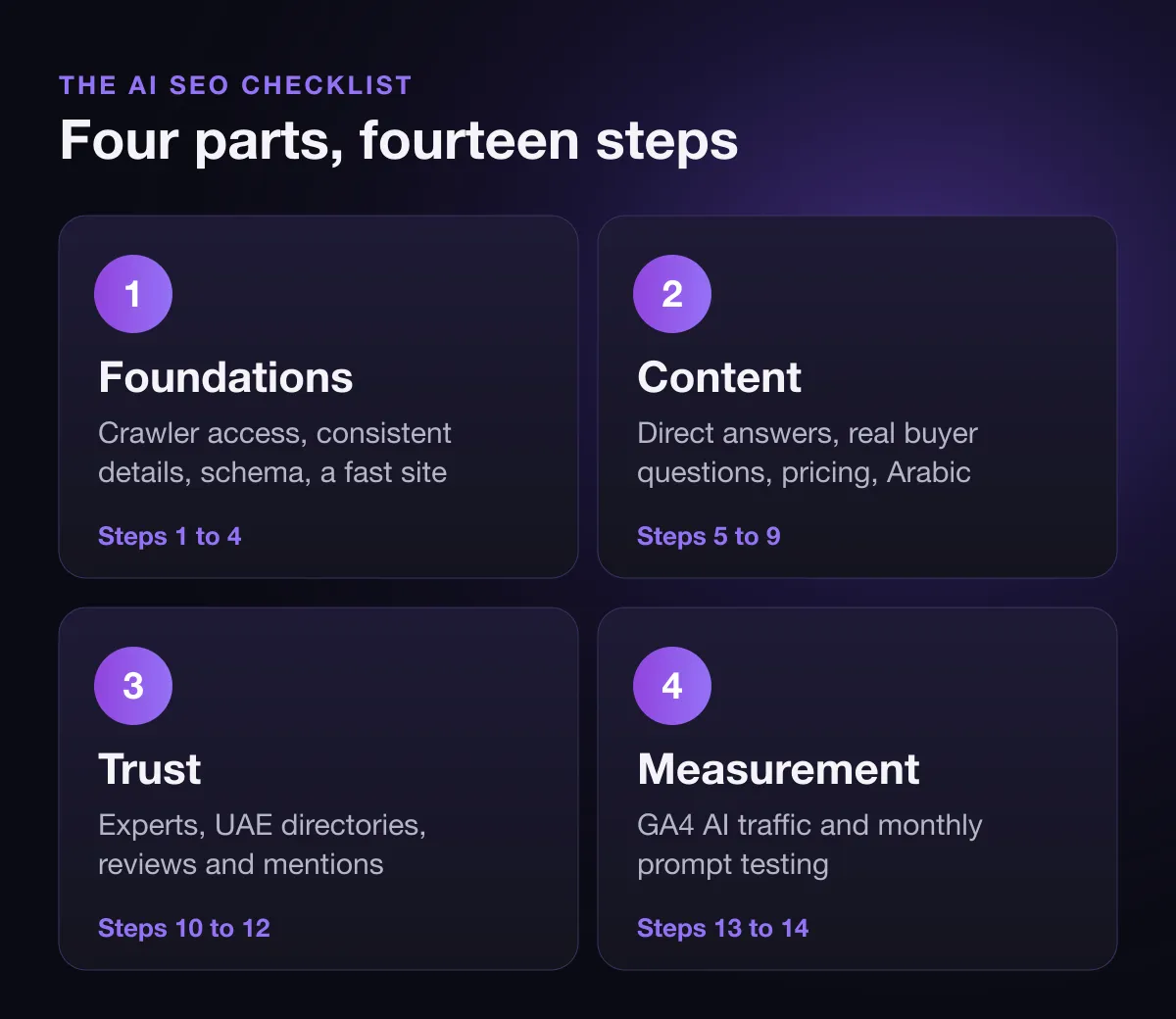
The checklist is split into four parts: foundations, content, trust and measurement.
Part 1: Foundations AI tools can read
1. Let AI crawlers into your website
An AI can’t recommend a website it can’t read. Open yourwebsite.com/robots.txt and check you’re not blocking the crawlers behind AI search:
- OAI-SearchBot and GPTBot (ChatGPT)
- PerplexityBot (Perplexity)
- Googlebot (Google AI Overviews) and Google-Extended (Gemini)
- Bingbot (Microsoft Copilot, and one of the sources ChatGPT search draws on)
- ClaudeBot (Claude)
Security plugins and hosting firewalls sometimes block these without telling you. It takes two minutes to check, and it’s one of the most common problems I find on otherwise good websites.
2. Make your business details identical everywhere
AI tools piece together who you are from lots of sources. When your website shows one address, your trade licence another and HiDubai a third, the AI can’t be sure they’re all the same business.
This is especially common in the UAE. Plenty of companies have a free zone licence address, work from somewhere else, and trade under a brand name that’s different from the legal name on the licence. Choose one version of each detail and stick to it:
- Name: your brand name, with the full legal name (L.L.C, FZE or FZ-LLC) in your footer and on your contact page
- Address: word for word as it appears on your trade licence
- Phone: one number, always written the same way, for example +971 4 123 4567
- Website and email: one domain, used everywhere
3. Add structured data (schema)
Schema is a bit of code that spells out what your business is, where it’s based and what it offers, so search engines and AI tools don’t have to guess. Start with these:
- Organization (or LocalBusiness) with your name, legal name, address, phone, logo, the areas you serve, and links to your official profiles using
sameAs - Service for each service you offer
- Person for your founder or key experts
- Article on your blog posts, with the author and dates
A quick note for 2026: Google has stopped showing FAQ drop-downs in its results. Keep your FAQs and FAQ schema anyway, because AI tools still use them to understand your answers.
4. Keep your site fast and simple to read
AI crawlers read pages much like a very basic browser. Anything that only appears after heavy scripts load, or that’s baked into images and sliders, can be missed. Keep your services, prices, locations and contact details in plain text. A fast, lightweight site helps your normal Google rankings too.
Part 2: Content AI tools want to quote
5. Answer the question first
AI tools love a direct answer they can lift. Open each important page with two or three sentences that answer the main question, then go into the detail. Say someone asks “How much does a Google Ads campaign cost in Dubai?” The page that opens with a clear figure and what affects it gets quoted. The page that makes you scroll past three paragraphs of introduction usually doesn’t.
6. Write for the questions buyers actually ask
Think about the full questions your customers type into ChatGPT, or say out loud to it, and answer them on your website. UAE buyers want local, practical detail, so include it:
- the emirates and areas you cover, such as Dubai Marina, JLT, Business Bay or DIFC
- who you work with, for example B2B companies, clinics or free zone start-ups
- prices in AED, licensing requirements, timelines and the languages you speak
Headings written as questions, like “How long does SEO take in the UAE?”, make your answers easy to find. Short paragraphs make them easy to reuse.
7. Be specific and original
ChatGPT can write generic advice on any topic in seconds. What it can’t do is make up your experience. The pages that get cited include things only you know: real results (“cut cost per lead by 91%”), the way you actually do the work, your pricing, your data, your opinions and your client stories.
If your page could have been written by anyone, an AI has no reason to pick it over the hundred others saying the same thing.
8. Show transparent pricing where you can
Price is one of the first things people ask AI tools about. “How much does a corporate lawyer cost in Dubai?” If your website gives a starting price or a range, the AI can quote it. If all it says is “contact us for a quote”, the AI quotes a competitor who was more open. Even a rough guide price builds trust and gets you into more answers.
9. Cover English and Arabic where it matters
A lot of UAE buyers search in English, but plenty search and ask in Arabic. If your customers include Arabic speakers, add Arabic versions of your key pages, written properly by a person rather than machine-translated, and use hreflang tags so search engines show the right language. At the very least, keep your business name and services consistent in both languages wherever they appear.
Part 3: Trust signals AI tools check
Google has a name for this: E-E-A-T, short for Experience, Expertise, Authoritativeness and Trustworthiness. It’s how Google’s quality guidelines judge whether content deserves to rank, and AI tools look for the same signals before they recommend anyone.
Here’s how the checklist maps to it:
- Experience: real results and first-hand detail (step 7)
- Expertise: named people with real credentials (step 10)
- Authoritativeness: trusted directories, reviews and mentions (steps 11 and 12)
- Trustworthiness: consistent details, open pricing and genuine reviews (steps 2, 8 and 12)
You can’t add E-E-A-T with a plugin. You build it by showing, everywhere you appear online, that real and experienced people run your business.
10. Show who’s behind the business
AI tools lean towards sources with obvious, real expertise. Put author names, photos and short bios on your articles. Give your founder or senior people a proper profile page with their experience and a link to their LinkedIn. People recommend businesses run by people they can see, and AI tools behave much the same way.
11. Get listed on the directories AI tools trust
AI answers pull heavily from directories and review sites. For a UAE business, start with:
- Google Business Profile, if customers visit you or you serve a set area
- Bing Places, because Microsoft’s data feeds Copilot and ChatGPT search
- UAE directories such as HiDubai, Yellow Pages UAE and Connect.ae
- the main directory for your industry, such as Clutch for agencies or DoctorUna for clinics
- a complete LinkedIn company page
Use exactly the same details on every one (see step 2).
12. Earn reviews and mentions
Ask an AI for “the best” or “the most trusted” option and it leans hard on reviews and on what other people say about you. Work on both, every month.
Reviews: collect them on Google, Clutch, Trustpilot or whichever platform your industry uses. The easiest way is to ask happy clients directly and send them the link. Most people are glad to help.
Mentions: get your name on respected UAE publications and industry websites through expert comments, guest articles, awards and events. A single mention on a respected UAE news or industry site can do more for you than dozens of low-quality links.
Part 4: Measure what AI search sends you
13. Track AI traffic in GA4
Google Analytics 4 can show you how many people arrive from AI tools:
- Go to Reports › Acquisition › Traffic acquisition.
- Change the main dimension to Session source.
- Add a filter on session source, choose matches regex, and paste in this pattern:
chatgpt|openai|perplexity|gemini|copilot|claude
Save it so you can check it every month. Don’t worry if the numbers look small. These visitors have often been recommended to you by name, so they tend to be some of your warmest leads.
14. Test your visibility every month
The simplest test is to ask. Pick 10 to 20 questions your buyers would ask, and run the same ones through ChatGPT, Gemini, Perplexity and Google each month. For example:
- “Who are the best [your service] providers in Dubai?”
- “Which [your service] company in the UAE would you recommend for [your type of client]?”
- “How much does [your service] cost in Dubai?”
Note whether you’re mentioned, which competitors show up and which websites the AI cites as sources. Those sources are your to-do list: the places you need to be listed, reviewed or featured next. Once you’re tracking more than a handful of questions, a tool like SE Ranking can do this for you.
What about llms.txt?
You may have come across llms.txt, a proposed file that gives AI tools a plain-text summary of your website. It’s quick to add and won’t do any harm. That said, none of the big AI companies has confirmed they use it yet, so I’d treat it as a bonus. Steps 1 to 14 will do far more for you.
The quick AI SEO checklist
- AI crawlers allowed in
robots.txt - Business details identical everywhere
- Organization, Service, Person and Article schema added
- Key content in plain text on a fast site
- Pages open with a direct answer
- Content answers real buyer questions, with UAE locations and AED prices
- Specific, original content with real results
- Transparent pricing or guide prices
- English and Arabic covered where your buyers need it
- Real people and expertise on show
- Listed on trusted UAE and industry directories
- Reviews and mentions growing every month
- AI traffic tracked in GA4
- AI visibility tested every month
Frequently asked questions
What is AI SEO?
AI SEO means getting your business mentioned, recommended and linked in the answers AI tools give, including ChatGPT, Gemini, Perplexity and Google AI Overviews. You’ll also see it called generative engine optimisation (GEO), answer engine optimisation (AEO) or LLM SEO. They all describe much the same work.
Is AI SEO different from normal SEO?
It builds on it. You still need a fast, well-built website with good content and solid backlinks. AI SEO puts more weight on direct answers, consistent business details, reviews and mentions around the web, and on checking what AI tools actually say about you.
How long does it take to show up in AI answers?
That depends on where you’re starting from and how competitive your market is. Fixing crawler access, your business details and your key pages can make a difference within weeks. Building the reviews, listings and mentions you need for competitive questions usually takes three to six months.
Can I do this myself?
Yes. Most of this list can be done in-house, especially Parts 1 and 2. Where most businesses get stuck is keeping it going: testing questions across every AI tool, working out which sources AI trusts in your industry, and building your presence there month after month.
What this looks like in practice
Here’s a real example from a B2B managed IT services company in Australia. Over three months, we worked through this checklist on their website and tracked how often Google showed their pages in AI Overviews and AI Mode, using Google Search Console.
- Almost 50% more AI appearances a day: from an average of 148 a day in the first month to 218 a day in the third
- 15,661 appearances in Google’s AI answers over the three months
- 120 of their pages have appeared in AI answers, led by their main managed IT services page
The growth wasn’t overnight. It built steadily week by week, then stepped up in the final month as more of their pages started being used in answers. That’s typical. AI visibility compounds, the same way good SEO does.
Want me to do this for you?
I help businesses in Dubai and across the UAE get recommended by ChatGPT, Gemini, Perplexity and Google AI Overviews. I’ll show you what AI tools say about your business today and which competitors they recommend instead, then I’ll close the gaps.
See how AI Visibility works, or book a free growth call and I’ll run a quick AI visibility check on your business before we speak.